
By Paul Derrington, Jr.
CEO | Chief Engineer | Research Engineer | Editor, D-CSIL
5 min read
Key Takeaways
Salesforce introduced Koa Decisions on November 6, a single-token decision model it says is built on Google's open-weight Gemma. In the team's paper, 85.52% routing accuracy is for a GPT-OSS-20B Koa-decision variant on 587 internal utterances; the Gemma-4-26B variant scored 81.43%. The paper's routing latency chart labels that classifier GPT-OSS-20B, at 0.53 seconds median and 0.63 seconds at the 95th percentile, about 1.9 to 7.5 times faster than the frontier models tested. That speed is not a figure for the shipped Gemma model. The GPT-OSS-20B accuracy is within about 2 points of the top scores in the table (Claude-4.8-Opus 87.73%, Gemini-Pro-3.1 87.05%). A free demo runs with a Trailhead account, and Salesforce plans to bring the model into flows, Apex, prompt templates, and a developer API.
The paper's routing numbers
The 85.52% figure comes from the Salesforce team's paper, posted to arXiv on September 28 and revised October 10. On a set of 587 de-identified internal routing utterances, the GPT-OSS-20B Koa-decision variant scored 85.52%. The Gemma-4-26B Koa-decision variant scored 81.43% in the same table. Salesforce says the Koa Decisions product is built on Google's Gemma. The paper does not report an 85.52% score for that shipped Gemma model.
The paper calls the GPT-OSS-20B result competitive, within about 2 points of the strongest models it tested. Claude-4.8-Opus scored 87.73% and Gemini-Pro-3.1 scored 87.05%. Five of the nine frontier models in that comparison scored higher. The GPT-OSS-20B variant scored ahead of GPT-5 (83.99%) and Gemini-2.5-Pro (84.50%). The paper says the label inventory changes over time and that the dataset is not released.
The paper's routing latency chart labels its Koa-decision classifier GPT-OSS-20B: 0.53 seconds at the median, 0.63 seconds at the 95th percentile, about 1.9 to 7.5 times faster than the frontier models tested. The chart caption and nearby prose say "our classifier" without repeating the base-model name. Those latency figures belong to the labelled GPT-OSS-20B classifier, not to the shipped Gemma model. The 1.9 times comparison is against the fastest frontier model in that test, and 7.5 times is against the slowest. Models shared one serving interface, round-robin, at concurrency 1, with no batching and no client-side caching. The paper does not state the hardware. The times are end to end for one request, not a per-token measurement and not a production service-level agreement.
Jev, from TypeSafe AI, was not run on the intent-routing set. On endpointing and SST-2, the paper's latency figures are essentially tied: 0.53 seconds versus 0.55 seconds for Jev. The paper compares Jev's accuracy on SST-2, Amazon, and endpointing, not on routing. It also says the Koa-decision setup adds multimodal inputs and multi-label outputs that a single-label text system does not handle.
These are the team's own benchmark figures, not independently replicated results.
One token, one decision
A general-purpose language model writes its answer one token at a time, each token based on the ones before it. A decision model reads the whole request at once and produces its answer in one step, often a single token, roughly the size of a word. A short answer takes less computing to produce, and other software can act on it right away.
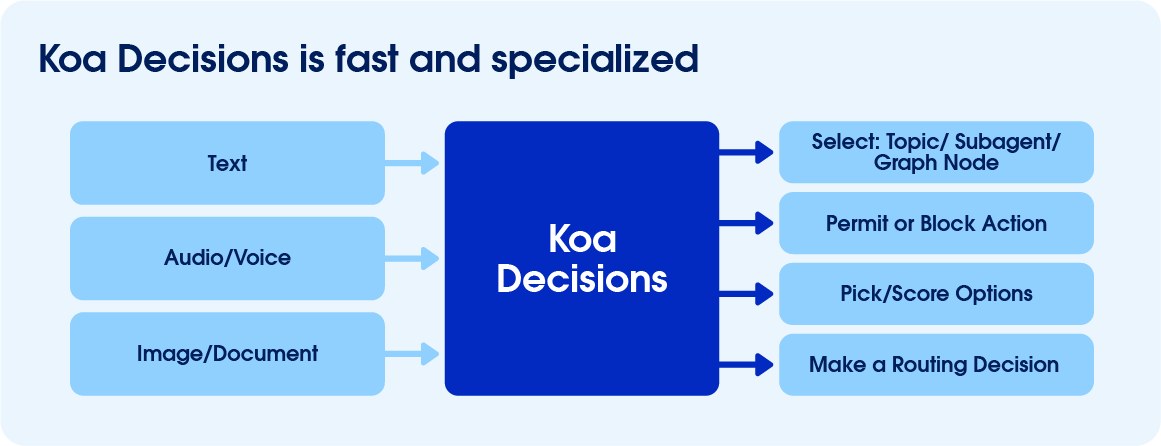
Salesforce's paper describes the method as constrained generation with single-token outputs: atomic label tokens and supervised fine-tuning reduce classification to a deterministic one-step decoding problem. Salesforce says the Koa Decisions product is built on Google's Gemma, an open-weight model, and that it can take images and audio as well as text.
Salesforce calls Koa Decisions the new version of Salesforce's decision model. Unite.AI, a secondary account, describes it as the next version of HyperClassifier. Citing a Salesforce engineering account, Unite.AI says HyperClassifier was fine-tuned on GPT-OSS-20B, can classify across as many as 200 labels, and became the default intent-detection and routing model for Agentforce Service and Employee Agent templates in spring 2026. Salesforce says Koa Decisions extends that routing job beyond routing.
26 milliseconds against 1.4 seconds
Salesforce says "our decision model" answered Agentforce routing requests in roughly 26 milliseconds, compared with about 1.4 seconds for a general-purpose LLM. The announcement does not name a base-model variant for that pair. Unite.AI attributes the measurement to HyperClassifier, 26 milliseconds versus 1,446 milliseconds. It is not presented as a benchmark of the shipped Koa Decisions model.
Salesforce says decision models make the quick calls, and large models do the writing and reasoning. Salesforce's example is a sales deal starting to slip: a decision model flags the risk and picks which team should step in, an LLM summarizes what changed, and by the time anyone opens the record, the right team already knows, via a Slack alert from the Sales Cloud record.
Salesforce says TypeSafe AI came out of stealth in mid-September with Jev, a model built to pick from a set of options, and that a month later OpenAI made its Decisions API generally available. Salesforce also says several other AI companies have released decision models of their own.
Try it now, and what comes next
Anyone can try the demo, Salesforce customer or not, with a free Trailhead account. The walkthrough routes a support request among engineering, accounts, and sales, then adds a fourth option, Returns, and asks about sending an order back. Salesforce says the model picks Returns with no retraining.
Software has classified requests for decades, but the older route was a custom predictive model: define the outcome, gather and label data, train, check accuracy, and repeat. Salesforce says that was months of work for many enterprise customers. A decision model starts from a language model that already relates sending an order back to returns, so a team can add the category and sometimes reach production in hours, Salesforce says.
Salesforce plans to extend Koa Decisions beyond routing, into flows, Apex, and prompt templates for Salesforce builders, plus an API for developers. Pricing and packaging are subject to change, availability varies by region, and access is governed by customer agreements.