
By Paul Derrington, Jr.
CEO | Chief Engineer | Research Engineer | Editor, D-CSIL
5 min read
Key Takeaways
In the first guest post on OpenAI's science blog, published November 15, UC Santa Barbara physicist Nathaniel Craig, a visiting scientist at OpenAI, says GPT-6 Astra helped turn his strategy into a candidate nonperturbative definition of the Standard Model on a lattice — a problem open for more than fifty years. Craig is clear about the limits: this is a candidate, experts still have to check it, and it cannot yet be used for realistic simulations.
The definition the Standard Model is missing
The Standard Model describes the known elementary particles and three of the four fundamental forces, and its predictions match experiments across eighteen orders of magnitude, from hydrogen's 21-centimeter radio emission to collisions at the Large Hadron Collider. Most of those predictions come from perturbation theory: solve the theory with its interactions switched off, then add the interactions back as a series of small corrections.
That works until it doesn't. The proton's mass, for example, comes mostly from the motion and interactions of the quarks and gluons inside it — switch the strong force off and the proton falls apart, so small corrections are the wrong tool. For the full Standard Model in continuous spacetime, physicists do not have a nonperturbative definition, one that keeps the interactions in from the start, and do not know whether the interacting theory is mathematically well defined. Putting the theory on a lattice — a grid of points representing spacetime — is the standard route around that, and it is how the strong force alone was already understood, including the proton's mass from first principles.
Why the weak force breaks the grid
The blocker is handedness. The weak force treats left-handed and right-handed fermions differently, which makes the Standard Model a chiral theory. Put a left-handed fermion on a lattice with the most natural rules and the grid hands you a right-handed partner you never asked for — the doubling problem. Craig explains it with light in a mirrored box: left-circular light bounces off an ordinary mirror and comes back right-circular, so the box ends up holding both. Special chiral mirrors fix the box, and lattice physics has its own version: overlap fermions, built by Rajamani Narayanan and Herbert Neuberger on rules from Paul Ginsparg and Ken Wilson, with Martin Lüscher showing how to tell left from right among them.
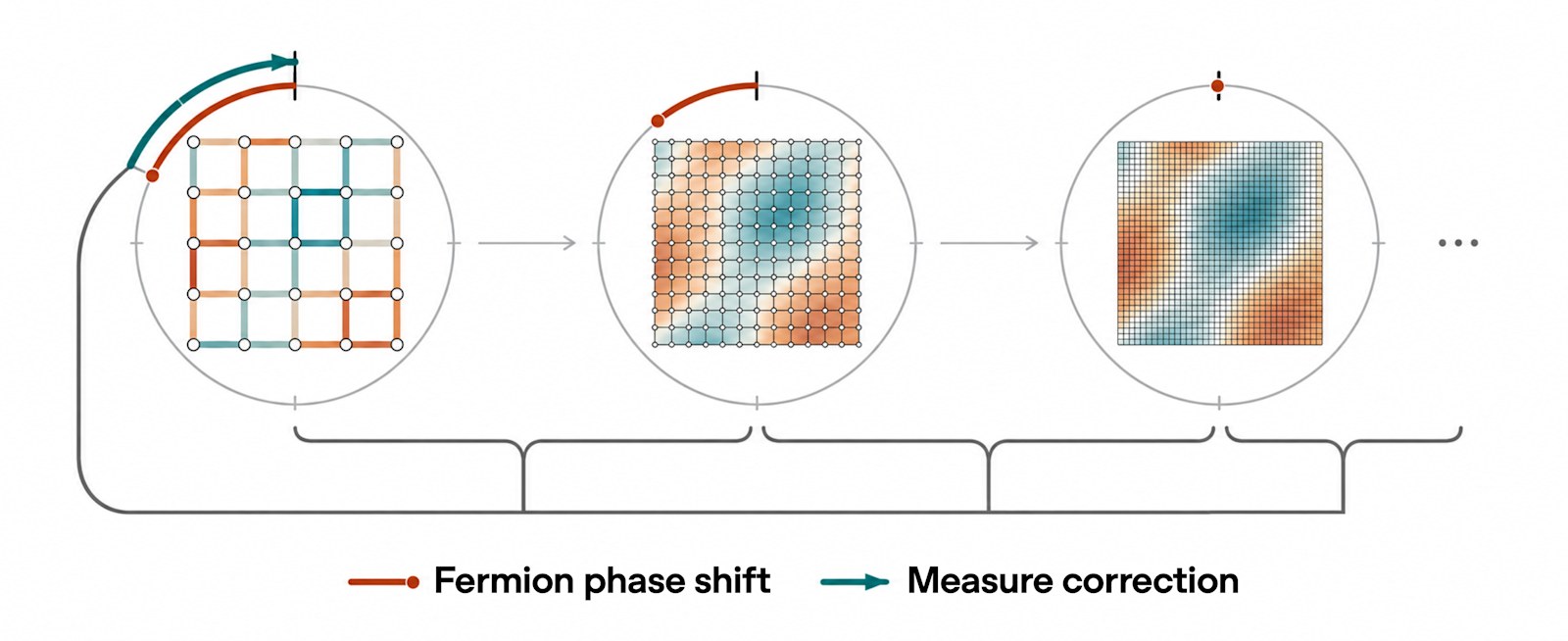
One piece stayed missing: the phase. As the force fields change around a loop on the lattice, the allowed fermion states pick up a phase that has to be compensated exactly, at every grid point. Lüscher worked out the phase prescription for a simpler class of theories, such as a chiral version of electromagnetism. For the full Standard Model, Craig writes, that alignment remained open for more than 25 years.
What Astra did, in Craig's account
Craig's idea was to take the force fields on the grid he cared about and represent the same fields on a succession of finer grids. Comparing the allowed fermion states on two neighbouring grids gives one part of the phase correction; adding those parts up gives the phase rule on the original grid. In a preprint posted October 6 — arXiv:2610.09093, with Craig as sole author, listing affiliations at UC Santa Barbara and at OpenAI, where he is a visiting scientist — he proposed that construction as a candidate nonperturbative lattice definition of the Standard Model, covering a class of non-Abelian chiral gauge theories that includes it. The construction applies to what the preprint calls admissible gauge fields: in Craig's post, fields under a bound on field strengths at the scale of the grid. The preprint is marked as prepared for submission to the Journal of High Energy Physics and has not yet been peer-reviewed.
His account of the model's role is specific. He had the strategy but, in his words, had not been able to prove it worked in all the cases it needed to cover. GPT-6 Astra, he writes, "was essential to turning the refinement idea into a working construction. It suggested the right way to carry a given set of force fields onto finer grids, showed that the comparisons on finer grids would converge to a definite answer, and took the lead in developing the detailed proof." Human experts were in the loop: lattice field theorists Maarten Golterman, Andreas Kronfeld and Yigal Shamir spent time looking over Astra's proof and asked probing questions that, Craig says, helped him build confidence in it. The preprint's acknowledgments say the manuscript combines author-written sections with extensive rewrites of the Astra-composed proof, and that tests proposed by Craig and colleagues, including Lean verification, were carried out by Astra. The preprint adds that Lean verification is not "the final word in physics."
A beginning, not an end — his words
The construction, Craig writes, is "much more a beginning than an end" and "far more an answer in principle than an answer in practice"; a lot of work remains before it is useful for realistic lattice simulations. He is still checking whether it satisfies reflection positivity at finite lattice spacing, a condition that connects lattice calculations to a quantum theory where probabilities are conserved, and defining the theory in continuous spacetime remains a separate open step. He writes that "scientific dialogue among experts is required" to decide whether the prescription has all the properties it needs.
Experts are already engaging with it on the record. In a note posted to arXiv on November 3, Edward Witten of the Institute for Advanced Study writes that Craig "overcame the difficulties and, with the aid of several new ideas, finally constructed a lattice regularization of chiral gauge theories in enough generality to encompass the Standard Model." Witten describes a variant of Craig's algorithm, which he notes was also proposed recently by Hsu, and says this approach "can be implemented on a computer in principle, but not in practice by Monte Carlo methods because the chiral fermion path integral is not positive."