
By Paul Derrington, Jr.
CEO | Chief Engineer | Research Engineer | Editor, D-CSIL
3 min read
Key Takeaways
NVIDIA introduced Nemotron for Science on November 16: its open Nemotron 3.5 Super VL model, a new open chemistry dataset of nearly 50,000 questions, and post-training recipes for building research agents. The model itself is not new — the kit around it is.
What did NVIDIA actually release today?
NVIDIA introduced Nemotron for Science at SC26 on November 16, bringing together the Nemotron 3.5 Super VL open model, scientific evaluations, a new open chemistry dataset and post-training recipes, according to the company's announcement. The idea is that researchers build agents that reason through a scientific problem and then call specialized research tools, including CUDA-X accelerated software, to do the computation.
The model underneath is not today's news. Its Hugging Face model card dates its release to October 15, and describes 120 billion total parameters with 12 billion active per token, text, image and video inputs, text output, and a context window of up to one million tokens. What is new is the science data, the evaluations and the customization recipes around it. NVIDIA said the model and the dataset are available now on Hugging Face, and that the model was also optimized to run locally on a 128GB DGX Spark system.
What is LitmusBench v0.2 for?
LitmusBench v0.2 is the new open dataset in the package, with nearly 50,000 questions for training and evaluating language models on chemistry reasoning. NVIDIA said it draws on molecular properties and experimental drug-discovery data, and is meant to improve how well a model predicts how molecules behave, including their solubility and how the human body processes them.
The companion technical blog shows how that data is meant to be used. Experimental records become question-and-answer pairs, and the measured outcome acts as an automatic verifier — no human preference labels needed. In its worked example, the model gets a parent molecule and an enzyme and has to predict the resulting metabolite, scored by a 0-to-1 Tanimoto similarity score against the reference molecule.
Do the numbers hold up?
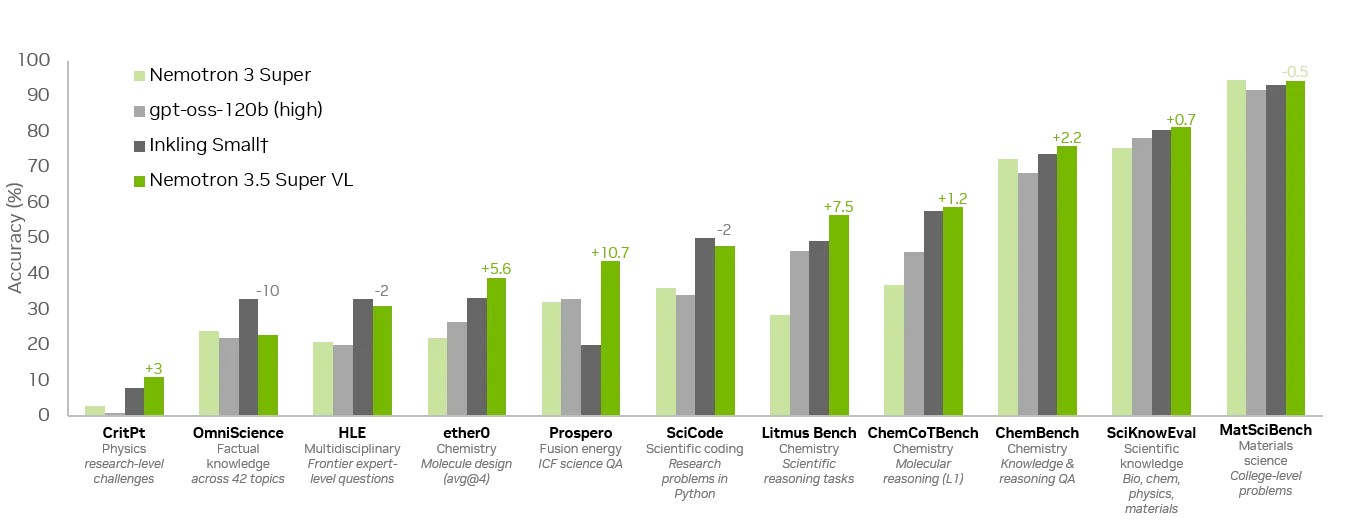
On NVIDIA's own chart — the hero image above — Nemotron 3.5 Super VL posts the top score on seven of the 11 science benchmarks shown, including ChemBench at 75.9 and Litmus Bench, against Nemotron 3 Super, gpt-oss-120b (high) and Inkling Small. Those are NVIDIA's figures, not an independent run.
The post-training numbers are narrower, and NVIDIA keeps them that way. At a 16,384-token output budget on its drug-metabolism reinforcement-learning environment, supervised fine-tuning improved accuracy by 12% and reinforcement learning added a further 17%, according to the technical blog. That describes that one task and that one model variant — not science tasks in general.
Who is already using it, and what is the catch?
NVIDIA named real deployments. Argonne National Laboratory is integrating Nemotron into StructBioReasoner, its multi-agent system for protein-based therapeutic candidates, and RIKEN has made the models available on its RIKYU platform through its RiVault gateway. KTH Royal Institute of Technology built an agent that repairs broken GROMACS molecular-dynamics setups; NVIDIA said it fixed 81% of test cases in one overnight run on a single DGX Spark, with every fix checked by GROMACS itself. Life-sciences companies Lila Sciences, Terray Therapeutics and Therna are also using and customizing the model, NVIDIA said.
The catch is attribution. The partner gains in the announcement — Terray recovering about 76% of annotated reactions on the RxnScribe test, Lila reaching 61% accuracy on quantum-dot synthesis against GPT-6 Astra's 54%, Therna's scientists preferring the tuned model's explanations in 96% of comparisons — are all NVIDIA-reported results on bounded tasks. None of them, on its own, shows general laboratory autonomy, and there is no independent replication yet. Ian Buck, NVIDIA's vice president of hyperscale and high-performance computing, put the pitch plainly: Nemotron for Science gives researchers “open models, scientific data and post-training recipes to build specialized agents.” Whether a given agent is any good still depends on the verifier scoring it.