
By Paul Derrington, Jr.
CEO | Chief Engineer | Research Engineer | Editor, D-CSIL
4 min read
Key Takeaways
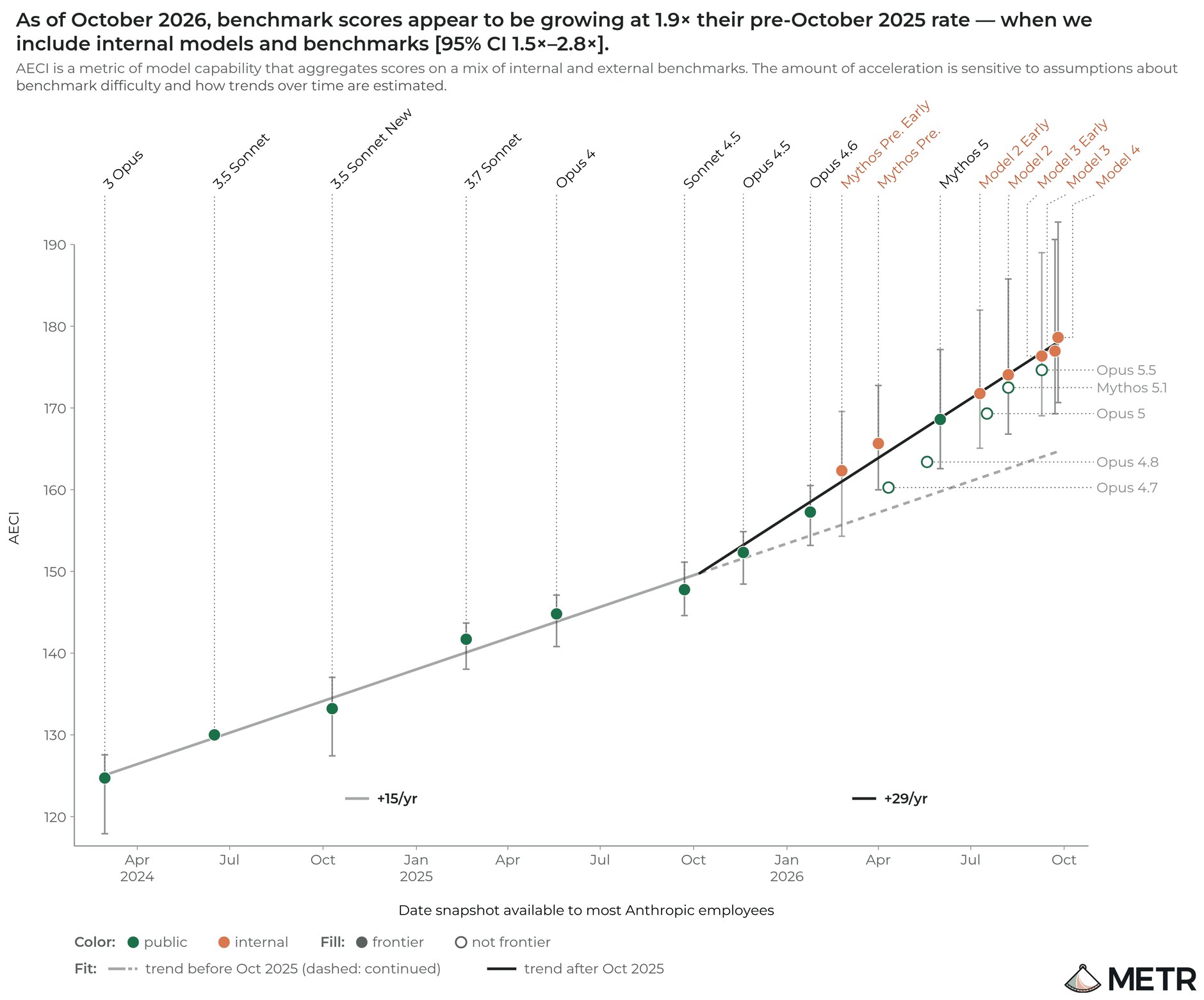
METR estimates that since October 2025, Anthropic's AECI benchmark scores have grown at about 1.9 times the earlier rate, with a 95% confidence interval of 1.5 to 2.8 times. That empirical estimate is separate from METR's subjective view: as of October 2026, progress on well-specified tasks is likely about twice the March 2024 to October 2025 rate, and METR would not be surprised if the true rate were closer to 1.3 times or 3 times. These figures are METR's estimates, not independently replicated results. Anthropic redacted a majority of the evidence METR found most informative, so the public has to take the headline figures largely on METR's word.
What METR found
METR, an independent AI evaluation nonprofit, ran a high-access assessment at Anthropic from August 12 to October 29, 2026, with about two and a half full-time staff working on Anthropic devices. Anthropic gave METR internal data on pretraining and reinforcement learning, training compute, benchmark scores for internal models, and interviews with staff.
METR's headline empirical estimate is that benchmark scores for Anthropic's models, measured by AECI, Anthropic's version of the Epoch Capabilities Index, have been growing at 1.9 times the pre-October 2025 rate, with a 95% confidence interval of 1.5 to 2.8 times. METR says that implies roughly two years of historical progress in one year. METR's chart of the index shows the fitted trend steepening from about 15 points a year before October 2025 to about 29 points a year after. METR's separate illustration of an exact twofold ratio uses 15 points a year rising to 30, which is a worked example, not the fitted trend. The newest internal model in the data, which METR calls Model 4, scored 178.6 on the index.
That 1.9 times figure is METR's estimate of benchmark-score growth. METR's broader subjective judgment, given with high uncertainty, is different in scope: as of October 2026, Anthropic is likely improving its models on well-specified tasks at around twice the rate it did between March 2024 and October 2025. METR says it would not be surprised if the true rate were closer to 1.3 times or 3 times, and it has additional uncertainty about broader, less well-specified tasks.
Why it matters
METR's subjective estimate is that a majority of the current acceleration — perhaps about 80% — is due to AI doing research and development work, with substantial uncertainty around that figure. Interviews with Anthropic staff centered on about a twofold speedup from AI use, and METR says it is confident the acceleration was not caused by faster growth in training compute.
METR says that if AI systems significantly accelerate further AI development, that could lead to a sudden emergence of extreme and risky capabilities. It describes a key concern that acceleration could compound as more capable models speed the next round of work, and it reports a significant risk that further capabilities progress could lead to even faster acceleration over the coming year. METR says it found no clear bottleneck in algorithms, compute, or data that would stop the acceleration over the next 12 months, but its view of the bottlenecks changed several times during the assessment, so it is not confident in that call and says it may be missing important bottlenecks.
METR also reports two checks on that headline. Staff Slack polls put their own felt speedup near 12 times for the newest model, but METR calls that very loose evidence: the 12 times is how fast individuals feel, not how fast the lab's measured capability is rising. METR's 1.9 times estimate also moves with analysis choices. Swapping the link function that turns benchmark scores into ability estimates gives 1.1 times to 2.9 times, and METR says the fit is fairly similar for most of those functions. Other choices, including which snapshots, benchmarks, or regularizer to use, cluster nearer 1.9 times to 2.2 times.
What happens next
METR is clear about what it did not find: AI is not yet making highly significant, fully autonomous contributions to the most important parts of model training, though METR saw early signs that autonomous contributions could grow. The report is also not proof of recursive self-improvement — it is a rate estimate over one year at one lab, built on an index whose benchmark names are redacted.
Much of the case stays out of public view. Anthropic redacted a majority of the evidence METR found most informative, a planned check of how compute is split between capabilities and safety work was cancelled midway at Anthropic's request, and the roughly 100-page full report has not been published. METR says a separate review of the AI R&D section of Anthropic's August 2026 risk report is being published alongside this assessment. METR cites a 1.7 times acceleration figure from Anthropic's Haiku 5.5 system card and says its own 1.9 times estimate is higher primarily because it includes newer unreleased Anthropic models. METR also estimates about 1.4 times acceleration when the same AECI approach is applied to frontier models from all developers, not only Anthropic, and it does not treat that 1.4 times figure as a settled replacement for the 1.9 times Anthropic estimate.