
By Paul Derrington, Jr.
CEO | Chief Engineer | Research Engineer | Editor, D-CSIL
4 min read
Key Takeaways
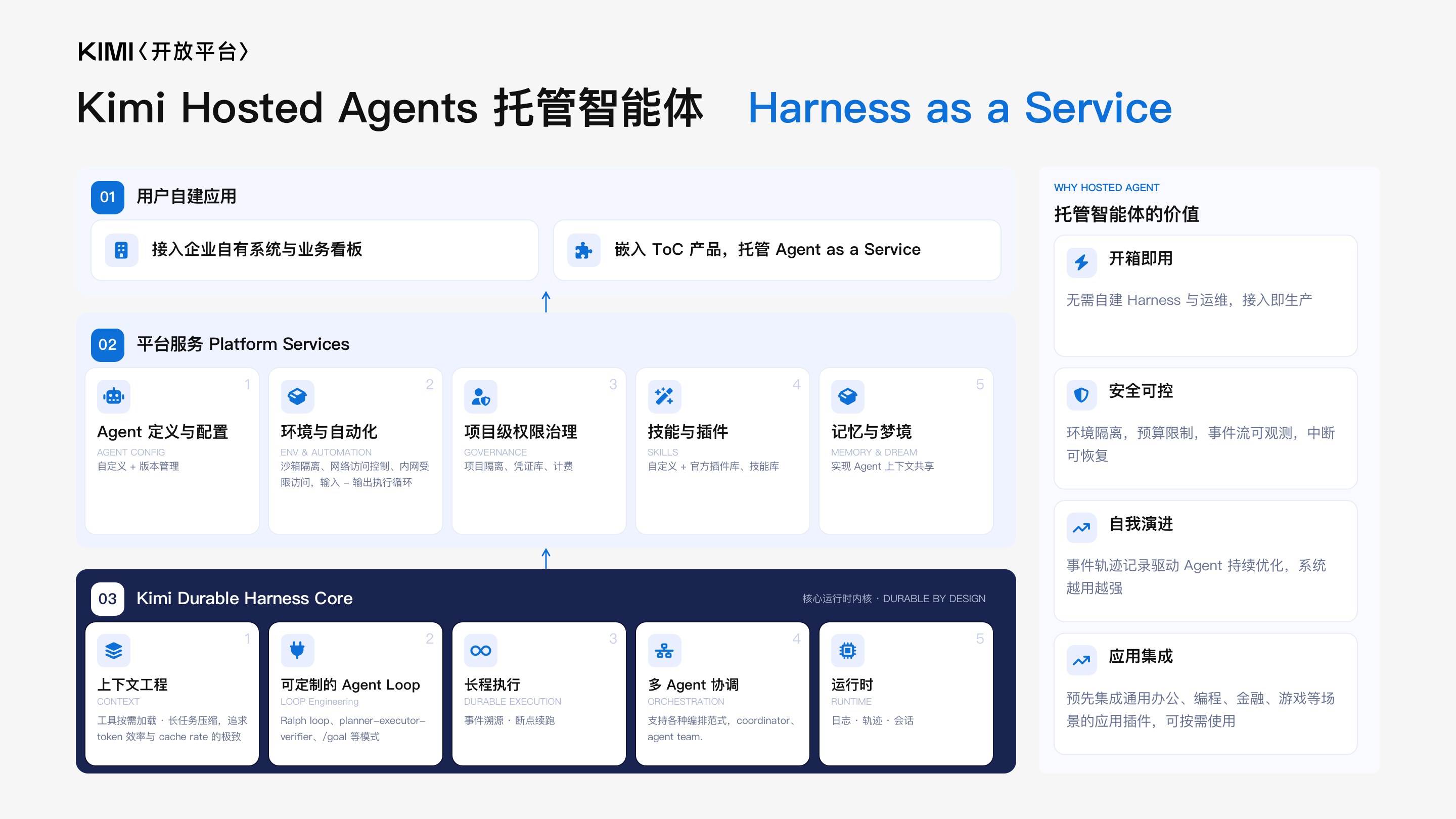
Moonshot AI formally launched Kimi Hosted Agents on November 5, according to Unite.AI and TechInAsia. Kimi’s docs describe it as a managed cloud service that provides the agent harness—sessions, sandboxed tool execution, and failure recovery—so enterprises and developers do not have to build that runtime themselves. Kimi says the service includes more than 140 skills, more than 30 plugins, and an optional Inference Hook that can screen content before each model call.
What Moonshot announced
Unite.AI reported on November 5 that Moonshot AI formally launched Kimi Hosted Agents, a cloud service for enterprises and developers to run AI agents without building or maintaining the framework underneath. TechInAsia published a same-day headline saying Moonshot launched a hosted AI agent service for enterprise.
Unite.AI says the service had already appeared in beta in September 2026 for domestic enterprise-verified users; Kimi’s Hosted Agents changelog includes September 2026 entries, and the docs still show a Beta label. According to Kimi, the service runs on the Kimi API Open Platform and provides a 24/7 hosted environment for long-running or asynchronous work and multi-agent collaboration.
It is separate from Moonshot’s Kimi K3.1 Pro model. Kimi’s docs describe K3.1 Pro as a roughly 3-trillion-parameter model with a 1-million-token context window and said complete model weights would be released by November 4, 2026. Hosted Agents, as Kimi frames it, moves from supplying a model to operating the environment the model works in.
What Kimi says the hosted harness handles
According to Kimi’s platform documentation, Hosted Agents provides the operational layer most agent projects otherwise build themselves: session history, tool execution, sandboxes, and failure recovery. Kimi says the platform stores complete session history as events, runs built-in tools in isolated cloud sandboxes, handles retries and scheduling, and automatically resumes after a platform failure with behavior consistent with the pre-interruption state.
Kimi says the service is stateful: session history, sandbox state, and output files persist on the server, and its event stream supports resumption with a Last-Event-ID header after a disconnected client reconnects. Developers can work through a web console, a REST API, or the kha command-line interface; console use needs an account login, while CLI and cURL workflows use an API key.
For multi-agent work, Kimi says a coordinator agent delegates subtasks to child threads within the same session, with between one and 20 agent entries in the delegation configuration. Synchronous delegation waits for a child thread to report, become idle, or terminate; asynchronous delegation returns as soon as the child starts, with the report delivered later. Kimi says child threads cannot create another level of child threads or communicate directly with one another, and each thread keeps separate status, history, and event streams.
Skills, plugins, and templates
Kimi says Hosted Agents includes more than 140 skills and more than 30 plugins covering web retrieval, professional data queries, office-document processing, and content generation. Enterprises can add custom skills, plugins, MCP services, and tools to connect their own systems and data sources.
The documentation lists 12 official agent templates: eight financial templates plus game-development, player-advisor, SRE incident-response, and Discord community-operations examples. The financial templates cover modeling, deep research, morning reports, IPO tracking, and portfolio reviews; Kimi says enterprises can copy them into their own projects and connect internal systems and private databases.
Kimi positions the service for internal business monitoring, research, and operations response, and for customer-facing assistants such as investment-research helpers and in-product strategy advisers.
Controls and self-hosting limits
Kimi describes the control layer as independent sandboxes, network-access controls, configurable operating boundaries, session interruption, execution records, and audit export. Operators can stop a session at any time.
Kimi Inference Hook connects to an enterprise-built or purchased security service and inspects task inputs and tool returns before each model inference. The enterprise defines the rules, and the hook allows or rejects the content. Kimi says the hook is offered selectively to enterprise-verified users.
A self-hosted environment moves sandbox tool execution to a customer-managed host, while Kimi’s platform continues to handle model calls, agent orchestration, and session management. Kimi states that self-hosting is not equivalent to private deployment, because tool inputs and execution results still pass through the platform’s model-inference interface. Kimi says the self-hosted version does not support IPython, image-search tools, or save_artifact, and that uploaded files, skills, and memory are not mounted on the worker host. That option is also restricted to enterprise-verified users.
Pricing
According to Kimi’s pricing page, Hosted Agents is pay-as-you-go with three parts: sandbox runtime at ¥0.072 per hour (about one US cent), model inference charged at the selected model’s token rates, and plugin charges based on call counts and each plugin’s unit price. Kimi says usage reports are designed to show resource consumption and costs by agent project.
The Inference Hook and the self-hosted environment are gated to enterprise-verified users, and the platform documentation checked for this pass is in Chinese. Capability and pricing figures above are Moonshot’s own; no independent benchmark of the hosted service was found.