
By Paul Derrington, Jr.
CEO | Chief Engineer | Research Engineer | Editor, D-CSIL
4 min read
Key Takeaways
Google added two systems to its eighth-generation TPU lineup on Monday: TPU 8tx for confidential inference and TPU 8i Max for massive context windows. It is the first time Google has introduced four TPU systems in a single year. Neither system has a published price or availability date yet; Google's Amin Vahdat told Bloomberg both are expected next year.
What did Google announce?
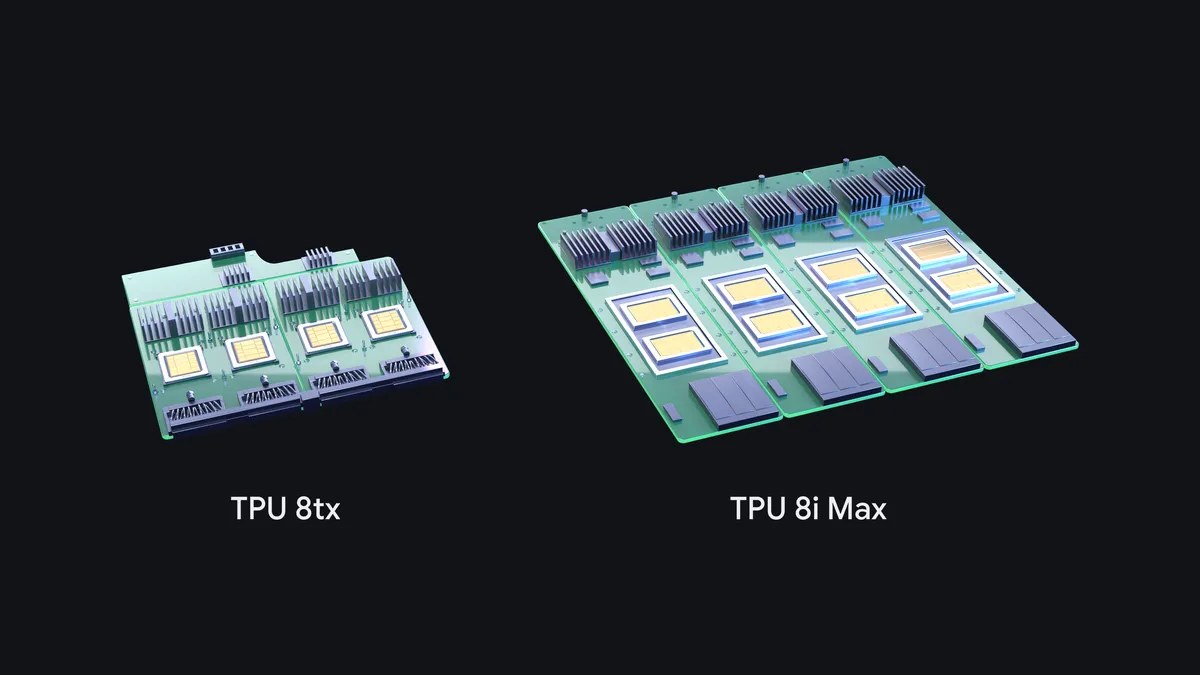
Google added two systems to its eighth-generation TPU lineup on Monday, November 9: TPU 8tx for confidential inference and TPU 8i Max for massive context windows. They join TPU 8t, built for large-scale training, and TPU 8i, built for real-time reasoning, both introduced at Google Cloud Next in April. "This is the first time we have introduced four TPU systems in a single year," wrote Amin Vahdat, Google's senior vice president and chief technologist for AI and infrastructure, in the announcement. Google says the April pair offers up to 2.7 times better training performance and 80% better inference price performance than the previous generation of TPUs.
Google calls these new systems, not new chips. Designing a new chip takes years; a system is the compute, memory, networking and security packaged around existing silicon, which Google says it can reconfigure in months. Vahdat calls the approach "building the computer around the chip." The pitch is a purpose-built accelerator for every stage of what Google calls the agentic lifecycle: 8t for training, 8i for reasoning, 8tx for confidential computing and 8i Max for massive context. Google says TPUs are now a growing business with nearly 100 customers, including frontier labs, trading firms, retailers and universities.
What does TPU 8tx actually protect?
Google describes the problem 8tx addresses this way: data is normally encrypted while it is stored or sent over a network, but it has to be unlocked in memory while a computer works on it. That is the moment sensitive data is exposed. TPU 8tx builds security into the hardware layer, keeping sensitive data and model weights "protected and isolated even while in active use," according to Google. It is built on the same silicon as the training-focused TPU 8t, paired with 5th Generation AMD EPYC host processors, and uses the low-latency Boardfly network Google created for the 8i. AMD calls it the first cloud TPU system with hardware-enforced confidential computing.
The intended customers are regulated enterprises and governments running frontier or proprietary models and autonomous agents alongside their most sensitive data. Google says 8tx also handles small-scale training, and that teams can fine-tune models on private data, distill large models into smaller ones, and train agents through reinforcement learning on the same system, without moving sensitive data between separate clusters. Google claims up to 2x lower latency than TPU 8t with a near-zero performance penalty for the added security. That is Google's own figure; no independent test has been published.
What is the memory wall, and how does 8i Max answer it?
When dozens of AI agents work together across an entire software codebase or hours of video at once, Google says memory bandwidth, the speed at which processors can get the data they need, quickly becomes the bottleneck. Google calls this the memory wall. TPU 8i Max answers it by putting two low-latency TPU 8i chips on a single package, delivering double the compute, double the on-chip SRAM and double the HBM bandwidth of a single 8i.
Because 8i Max fits twice the silicon in the existing rack footprint, Google says data centers can deploy significantly more computing power per square foot and per watt. Network World, citing Google, reported 384 GB of high-bandwidth memory, about a third more than the 8i, with 17.2 TB per second of memory bandwidth and 768 MB of on-chip SRAM. The point of all that memory is context: agents reasoning across million-token windows without stalling while they wait for data.
When can anyone use these, and what is still unproven?
Not yet, and Google did not say when. The announcement gives no price, no availability date and no named customer for either system. Vahdat told Bloomberg both are expected next year, in 2027; TechTarget notes the earlier 8t and 8i are still due to come online by the end of this year. Every performance figure in this story is Google's own published claim. No independent benchmark has been published for either system.
The hardware is only half the announcement. Google also moved on the software side: it open-sourced TorchTPU last month so PyTorch code and Hugging Face models run natively on TPUs, put a TPU agent suite that plugs into Claude Code, Cursor and Antigravity into preview, and open-sourced TPU Sync, a model-state layer for TPU clusters. Google says its aim is to make TPUs as easy to use as general-purpose hardware.