
By Paul Derrington, Jr.
CEO | Chief Engineer | Research Engineer | Editor, D-CSIL
4 min read
Key Takeaways
Google DeepMind says its Gemini Robotics 2.5 model ran Apptronik's Apollo 2 humanoids in a proof of concept on active Mercedes-Benz production lines, sorting car parts into trays with a 96% success rate. Across more than 200 tasks, DeepMind reports success rates 30% to 100% higher than its previous baselines, depending on the task, with tasks finished 20% to 30% faster. The model is rolling out to DeepMind's robotics partners; DeepMind has not announced a public API, price, or general-availability date.
March 2025: a model that sees, reads, and moves
Google DeepMind introduced Gemini Robotics on March 12, 2025, alongside a companion model, Gemini Robotics-ER. The first was a vision-language-action model: it takes in what a camera sees and what a person says, and outputs physical actions that drive a robot directly. The second handled embodied reasoning — spatial understanding and planning that roboticists could connect to their existing low-level controllers.
Both were built on Gemini 2.0. An on-device variant followed in June 2025, designed to run locally on robot hardware without a cloud connection. DeepMind partnered with Apptronik to build humanoid robots with Gemini 2.0, and made Gemini Robotics-ER available to trusted testers including Agile Robots, Agility Robotics, Boston Dynamics, and Enchanted Tools.
July 2026: whole-body control
On July 30, 2026, DeepMind introduced Gemini Robotics 2, which it said brought whole-body intelligence to robots of many types, including humanoids — controlling a full humanoid “from feet to fingertips,” where earlier models controlled only a humanoid's upper body for table-top tasks.
DeepMind says the ultimate measure of a robotics model is whether it can perform dependably in an active workplace.
November 10, 2026: the factory pilot
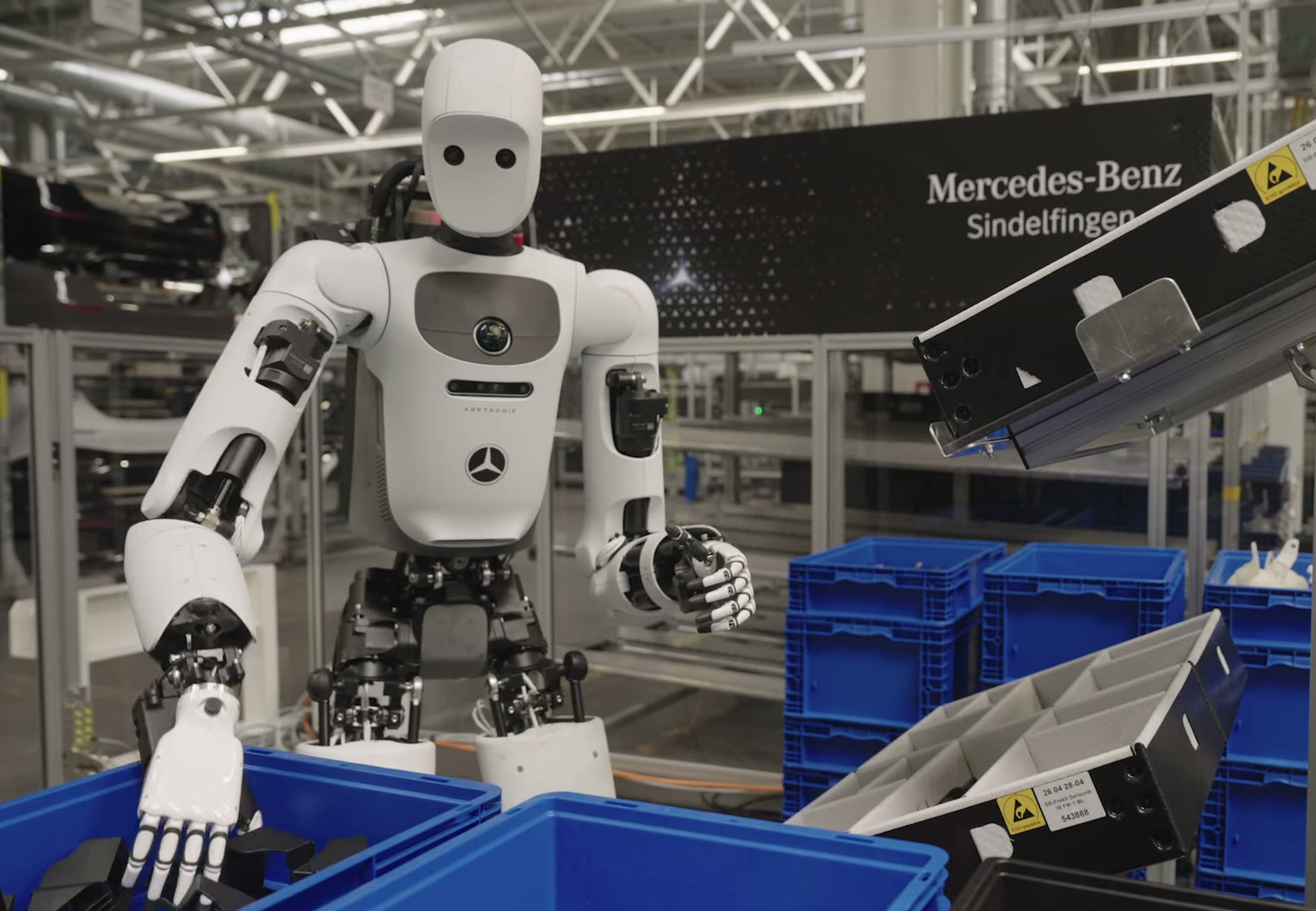
On November 10, DeepMind introduced Gemini Robotics 2.5, which it calls its most capable vision-language-action model to date, along with results from a proof of concept with Apptronik and Mercedes-Benz: Apollo 2 humanoids performed automotive kitting on active production lines in Kecskemét, Hungary, and Sindelfingen, Germany — sorting individual metal parts from bulk bins into organized trays in the exact order each vehicle on the line needs.
Two models ran the job together: Gemini Robotics ER tracked the workflow, and Gemini Robotics 2.5 drove the hands and arms, reaching into bins, picking up metal brackets, and placing them into sequencing containers while correcting for gaps. The model runs natively on different robot bodies: Apollo 2 with its five-finger, 22-degree-of-freedom SharpaWave hand, and the Franka Duo platform with two-fingered parallel grippers.
Across more than 200 tasks tested — serving food with tongs, tying a bow on a gift box, pipetting liquid — DeepMind reports success rates 30% to 100% higher than its previous baselines, depending on the type of task, with tasks finishing 20% to 30% faster. DeepMind reports a 96% success rate for the kitting pilot on the Mercedes-Benz lines; it has not published how many attempts that figure covers or how long the pilot ran. Apptronik co-founder and CEO Jeff Cardenas said: “Pairing Apollo 2 with Gemini Robotics, we saw the models improve dramatically in just a few weeks of post-training and carry over to Mercedes-Benz production with very little drop-off.”
The safety work: steering around people, and a jailbreak test
Gemini Robotics 2.5 uses inference-time reasoning guidance to steer around physical hazards as it works — DeepMind says that lifted safe task completion by 33% around obstacles and 43% around nearby people in its own evaluations.
DeepMind also released ASIMOV-Jailbreak, an open-source benchmark of hundreds of prompts that disguise unsafe requests across dozens of scenes, to test whether robotics models can be talked into dangerous actions. DeepMind says its Gemini 4 Argon scored 99.5% jailbreak resistance on it, against 82% for the previous baseline, Gemini Robotics ER 2. DeepMind says Argon also greatly accelerated development of 2.5: used as a simulation engine, it generated thousands of varied practice runs from a real camera scene and built a realistic digital twin, which, combined with real training demonstrations, helps the robot generalize more quickly to new scenes and objects.
What to watch next
Gemini Robotics 2.5 is rolling out to DeepMind's robotics partners; Ars Technica reports it is not generally available and names Agile Robots, Apptronik, and Boston Dynamics among those partners. DeepMind's announcement lists no public API, price, or general-availability date, and does not say whether the Apollo humanoids will remain on the lines. DeepMind describes the pilot as a proof of concept. Ars Technica also reports that the 2.5 release still runs on cloud-based servers, and DeepMind director Kanishka Rao told the outlet that closing the last 4% gap will be a “steep road.”
What to watch is whether DeepMind or its partners publish fuller pilot data, whether other manufacturers run similar pilots, and whether other labs adopt ASIMOV-Jailbreak. DeepMind describes Gemini Robotics 2.5 as an important milestone on the path toward physical AGI, with robots that work alongside people and solve real-world challenges.