
By Paul Derrington, Jr.
CEO | Chief Engineer | Research Engineer | Editor, D-CSIL
5 min read
Key Takeaways
Google launched the Gemini Decisions API on November 11, powered by a new model, Gemini Decision 1, that scores up to 1,000 yes/no, multiple-choice, or rubric questions about one shared input in a single pass instead of generating text. Google says it answers in 150 to 250 milliseconds end to end at $0.10 per million input tokens, with no charge for output tokens. In Google's own benchmark table it placed first in 7 of 9 tests; VentureBeat reported that the independent Artificial Analysis Decision Index v2.1 ranked it ninth of 18 decision models at launch.
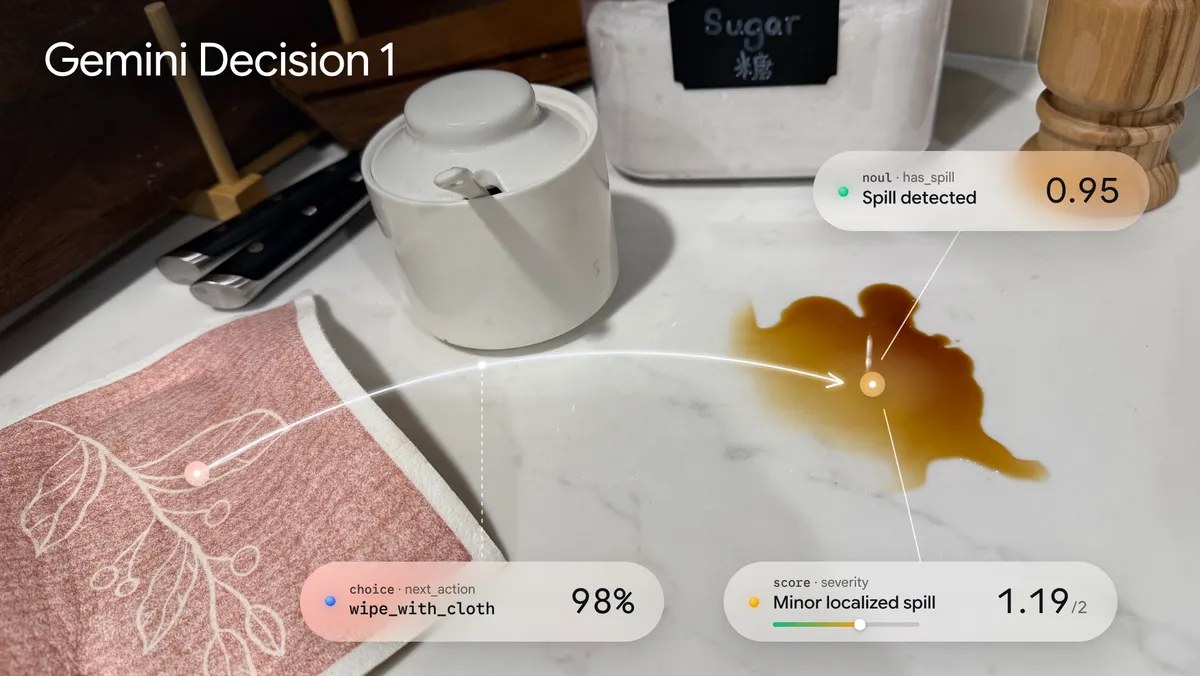
1,000 questions, one call
On November 11, Google DeepMind introduced the Gemini Decisions API, powered by a new model called Gemini Decision 1 (gemini-decision-1). It is built for one job: closed-set decisions — picking from a fixed list of answers instead of writing text. A single request carries one shared multimodal input — text, images, audio, video, or PDFs — plus up to 1,000 independent questions about it. Google's blog puts the input at up to 256K tokens; its model page lists a 262,144-token input limit that covers the shared input plus all questions.
Google says the model scores every candidate answer in a single forward pass and returns probabilities and confidence scores in 150 to 250 milliseconds end to end, with median model compute of 50 to 100 milliseconds. That latency stays nearly flat from 1 to 100 questions per request at contexts up to 16,000 tokens, according to Google.
Three kinds of question, no writing involved
The API offers three question types. A noul question asks yes or no — Google's example checks whether a photo of a breakroom counter shows an uncleaned spill. A choice question picks from 2 to 255 options and returns the winner plus normalized probabilities for every candidate. A score question grades against an ordered rubric starting at 0 and returns a continuous weighted score with per-level probabilities.
Every answer carries a confidence score from 0 to 1, so code can route ambiguous cases to a fallback or a human reviewer. Because nothing is generated token by token, there are no output tokens to bill — and no thinking-token bills, transcription, or OCR charges either, Google says.
The scorecard: Google's table and an independent index
In Google's own benchmark table, Gemini Decision 1 placed first in 7 of 9 tests against TypeSafe's Jev 1.14, OpenAI's GPT-6 Luna on the OpenAI Decisions API, and Google's own Gemini 3.5 Flash-Lite; VentureBeat notes it led five of the seven tests that all four models ran. On JevBench (public split) it scored 92.2% accuracy, against Luna at 90.9%, Jev at 90.0%, and Flash-Lite at 86.6%. It also placed first on Amazon ESCI product-search relevance (58.7% Macro-F1, against Jev's 56.7%), the text-only New Yorker Caption test (79.7%, against Flash-Lite's 73.7%), PubMedQA medical questions (79.8%, against Jev's 78.2%), and the non-English Global-MMLU-Lite test (86.0%, against Jev's 85.0%). On two media tests, Google compared it only with Flash-Lite: 71.8% to 67.7% on audio benchmark MMAU and 69.1% to 63.3% on Video-MME. Jev placed first on the other two: the Mind2Web Multimodal browser-task test, 86.8% to 86.2%, and the When2Call tool-use test, 82.0% to 79.9%. Google also reports the lowest calibration error in the comparison — a Top-1 expected calibration error of 0.0250, against 0.0494 for Jev and 0.0721 for Luna. All of these figures are Google's own and self-reported.
VentureBeat reported that Artificial Analysis' Decision Index v2.1, which combines six evaluations, put Gemini Decision 1 ninth of 18 models at launch, with a score of 65.98 and 211 milliseconds per task. On Artificial Analysis' When2Call run, Drex Max v1.1 scored 94.6% accuracy, Jev 80.8%, and Gemini Decision 1 75.2%. On AA-Paperclip, which asks 15 questions about each résumé, research paper, invoice, or receipt, Gemini Decision 1 got every answer right on 33% of documents, against 35.5% for Jev and 63% for Drex Max v1.1. VentureBeat also reports that Gemini led the index's knowledge and reasoning tests.
Other decision models, pricing, and availability
Google's launch follows other decision-model releases this fall. SiliconANGLE reports that TypeSafe AI launched Jev in mid-September. OpenAI opened its Decisions API in public beta on October 6 and made it generally available on October 22, Microsoft launched Microsoft-Decision-1 on October 9, and Salesforce introduced Koa Decisions on November 6. On list price, Gemini Decision 1 costs more per input token than Jev: TypeSafe lists Jev 1.14 at $0.042 per million input tokens, against Gemini's $0.10, and in Google's own table the shared benchmark suite cost $0.68 with Jev against $0.88 with Gemini Decision 1. Google's price comparison is with its own Flash-Lite: Google says Gemini Decision 1 with the Decisions API is nearly 5x cheaper across the shared suite, $0.88 against $4.14 for Gemini 3.5 Flash-Lite through the Interactions API.
The API is available now through the Gemini API (v1beta) in Google AI Studio, with a no-cost tier for prototyping. Google says ecosystem integrations are rolling out across OpenRouter, LangChain, Vercel, LiteLLM, Pydantic AI, Pipecat, LiveKit, and OpenCode, and that support is coming soon to Gemini in Google Cloud. Inside Google, the company says, the model routes queries in Gemini Notebook — serving everyday queries with up to 40% lower latency — picks emoji reactions from a palette of more than 200 options in CC from Google Labs, powers a rapid canvas experiment in Stitch, and serves as a safety layer for MCP tools in Search that detects adversarial behavior and content.