
By Paul Derrington, Jr.
CEO | Chief Engineer | Research Engineer | Editor, D-CSIL
4 min read
Key Takeaways
Google released Gemini 4 Neon on November 18, a mid-tier model priced at $3 per million input tokens and $15 per million output tokens. Independent testing by Artificial Analysis scores it 61 on its Intelligence Index at the xhigh thinking level — third overall, and one point ahead of Gemini 4 Carbon, Google's own flagship tier.
The number: 61, third overall
Artificial Analysis, which tests models independently, scores Gemini 4 Neon at 61 on its Intelligence Index at the xhigh thinking level — third overall, behind GPT-6.2 Astra (max) and Claude Fable 5.2 (max), and one point ahead of Gemini 4 Carbon (high). Google announced the same 61 score and the same third-place rank in its launch post on November 18.
The cost side of that score is where Neon makes its case. Artificial Analysis puts Neon (xhigh) at $6.44 per task, about 17% less than Carbon's $7.76 at Carbon's standard, non-discounted pricing, and at about 21 minutes per task against Carbon's roughly 36 minutes — about 40% less time. At its default high effort level, Artificial Analysis says Neon matches Carbon (high) at less than half the cost per task, again measured against Carbon's standard pricing. On coding agents, Google scores Neon first overall on the Artificial Analysis Coding Agent Index at 58.6; Artificial Analysis, running Neon through the Antigravity CLI at xhigh, scores it 59, three points ahead of Carbon (high, 55) and in line with Claude Fable 5.2 and Claude Opus 5.5, at $6.86 per task against $12.61 for Opus 5.5 and $15.47 for Fable 5.2.
A mid-tier model, live today — for paying users
Google positions Neon between its two other current tiers: Hydrogen handles fast, everyday execution, Carbon takes the hardest long-horizon projects, and Neon is built for complex coding, analytical reasoning and production-grade enterprise work that runs often. It takes text, image, video and speech input in a 1 million-token context window, and offers four thinking levels — low, medium, high and xhigh — so teams can trade intelligence against token spend per job. Neon is Google's fourth Gemini 4 model in seven weeks, Artificial Analysis notes.
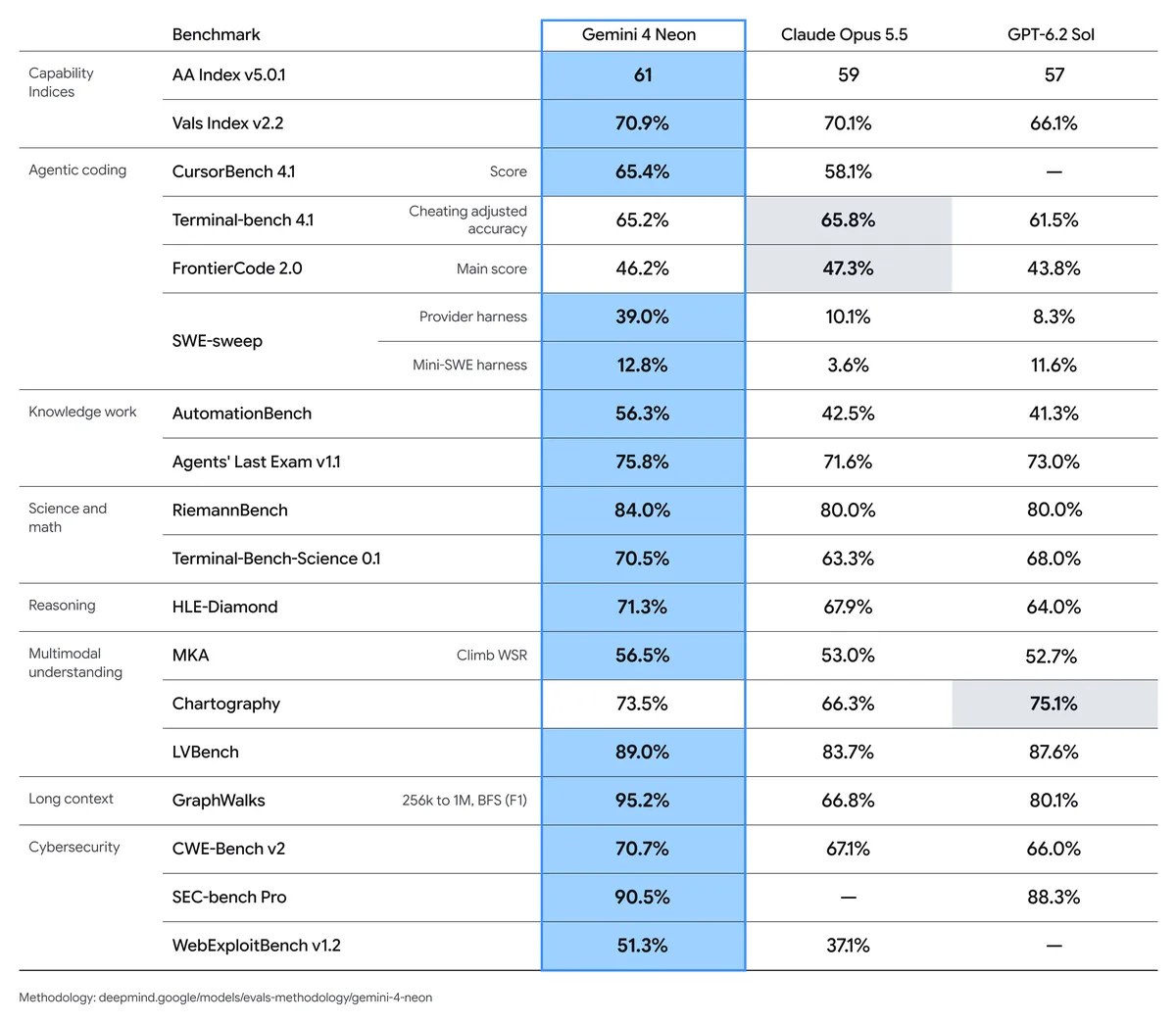
The rollout is specific, and narrower than a headline suggests. Neon is rolling out today in the Gemini API on the paid tier in Google AI Studio and Android Studio, in Gemini for business through the API and the model dropdown, and for paid Google AI Pro and Ultra subscribers in Google Antigravity and in the Gemini app. There is no free API tier for Neon at launch. A separate variant, Gemini 4 Neon for cyber, is not out today: Google says it rolls out to trusted defenders in the coming days through the Fairwind Program, and credits that variant with 90.5% on SEC-bench Pro and 70.7% on CWE-bench v2 in its cyber section.
The wins in Google's table — and the losses
Benchmarks, from Google's own launch table (Neon against Claude Opus 5.5 and GPT-6.2 Sol): Vals Index 70.9% (ranked #2), AutomationBench 56.3%, Agents' Last Exam v1.1 75.8%, Terminal-Bench Science 70.5%, RiemannBench 84.0% and HLE-Diamond 71.3%. Those are Google-reported figures; the independent check available at launch is the Artificial Analysis composite above, not a re-run of each row.
The same table leaves the losses in. On Terminal-Bench 4.1 (cheating-adjusted), Opus 5.5 edges Neon 65.8% to 65.2%. On FrontierCode 2.0, Opus leads 47.3% to Neon's 46.2% at its default high setting. On Chartography, which tests reading dense professional charts, GPT-6.2 Sol leads at 75.1% against Neon's 73.5%. And on SWE-sweep, the harness around the model swings the result more than the model does: 39.0% with Google's provider harness in Antigravity against 12.8% with the mini-SWE harness — the same model, a threefold spread, which VentureBeat flagged as the strongest reason to test Neon inside your own agent setup rather than trusting any single rank.
Read the price both ways before switching
Neon's sticker price is $3 per million input tokens, $0.15 per million cached input tokens (a 95% discount) and $15 per million output tokens. Against Carbon's standard rates of $4 and $20, that is 25% lower — but Carbon's introductory rates of $2 and $10 run through November 30, so per token, Carbon is the cheaper Google model for the rest of November, and Neon's 25% token-price edge only starts December 1. Against rivals, Neon's headline rates are 50% higher than GPT-6.2 Sol and Claude Sonnet 5.5, both at $2 and $10 — so Neon's value case rests on cost per finished task, not cost per token.
Artificial Analysis adds one more qualifier to that case: Neon uses about 15% more output tokens per task than Carbon, so its lower cost per task comes from its lower token prices, and its lower time per task from a higher output speed — about 110 output tokens per second against Carbon's roughly 57. The plain verdict: if your work is frequent, complex and currently running on a flagship tier, Neon is worth a test this week. If you buy on token price alone, Sol and Sonnet are still cheaper per token, and Carbon is cheaper until December.