
By Paul Derrington, Jr.
CEO | Chief Engineer | Research Engineer | Editor, D-CSIL
4 min read
Key Takeaways
Google introduced Gemini 4 Hydrogen on November 12, the fast tier of the Gemini 4 family and the successor to Gemini 3.8 Flash. Google says it finishes tasks 2.5 times faster than 3.8 Flash on Google's tests. On the Artificial Analysis Intelligence Index it scores 51 at its default high thinking level, against 50 for Gemini 4 Argon, and 54 at xhigh — figures Google reported and Artificial Analysis has published. It is rolling out in the Gemini app, Google Search, and the Gemini API at $1.50 per million input tokens and $7.50 per million output tokens.
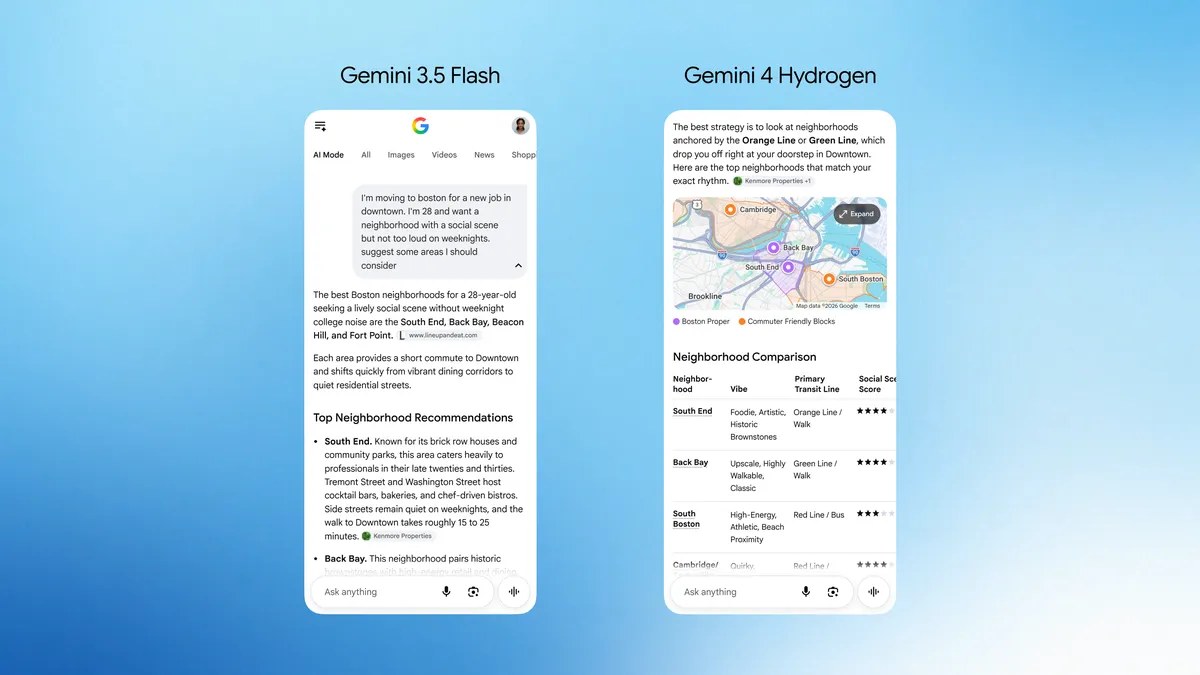
Gemini 4 Hydrogen, the new fast tier
Google DeepMind's Koray Kavukcuoglu introduced Gemini 4 Hydrogen on November 12 as the new fast tier of the Gemini 4 family, the role previously filled by the Flash models, including Gemini 3.8 Flash. Google says its frontier models, Gemini 4 Carbon and Gemini 4 Argon, excel at deep, long-horizon reasoning, while Hydrogen is built for rapid execution across diverse agentic workflows. Google says Hydrogen is rolling out globally across all tiers of Google AI Studio, the Gemini API, Gemini for business, the Gemini app, and Google Search, and to paid Google AI Pro and Ultra subscribers in Google Antigravity.
9to5Google reports that in the Gemini app's model picker Hydrogen is labeled "Everyday help." Google says free users get access through automatic model selection when it is the appropriate model for the prompt. 9to5Google, matching a November 12 post by Google Search VP Robby Stein quoted by Search Engine Roundtable, reports that Hydrogen is now the default model for AI Mode and is used for the hardest questions in AI Overviews. Google's Search blog says Hydrogen is available globally in Google Search for all users.
Hydrogen vs. 3.8 Flash: the numbers
Against Gemini 3.8 Flash, Google reports Hydrogen finishing tasks 2.5 times faster at its high default thinking setting, with Terminal-Bench 4.1 scores more than tripling, to 57% from 18.2%. Google also says fabricated claims are cut by more than 5x. In early testing across complex graphs, SQL, and data-heavy enterprise workflows, Google says its partners have seen Hydrogen run 2x to 2.8x faster while reducing token usage by 12% to 23%, compared with 3.8 Flash.
On the Artificial Analysis Intelligence Index, Artificial Analysis publishes a score of 51 for Hydrogen at high thinking and 54 at xhigh, against 50 for Gemini 4 Argon at high — the same figures Google reported. Google says Hydrogen leads its class on HLE-Diamond at 58.8%, ranks first overall on the Vals Tax Agent Bench at 52.3%, ties for first on the Vals Legal Research Bench at 55.8%, and leads its class on AutomationBench-AA. Google also reports 53.4% on its new Multimodal Knowledge Agent benchmark and 71.6% on Agents' Last Exam v1.1, and says Hydrogen ranks fifth on Agent Arena's live benchmark. Those remaining figures are Google's own reporting, including results in the Gemini 4 Hydrogen model card.
Thinking levels, Orchestrator, pricing, and safety
Google positions Carbon and Argon for deep, long-horizon reasoning and Hydrogen for rapid execution. Hydrogen has four thinking levels — low, medium, high (the default), and a new xhigh tier — which Google says scale so users only wait and pay for the reasoning depth a task requires. Google is introducing Orchestrator in Google Antigravity, which it says dynamically switches between models like Carbon and Hydrogen within the same session. On Terminal-Bench 4.0, Google says Orchestrator reached near-Carbon task success rates while, on average, consuming 24% less quota and completing 19% faster. For parallel-agent workflows, Google says Carbon can act as the coordinator while Hydrogen powers worker and verifier agents.
Google AI Studio pricing lists Gemini 4 Hydrogen (gemini-4-hydrogen) at a flat $1.50 per million input tokens and $7.50 per million output tokens, including thinking tokens, across a unified 1-million-token context window, with long-decode generation up to 1 million tokens. The model card says the default synchronous output limit is 64K tokens, with up to 1 million tokens available via background long decode. On safety, Google says Hydrogen reduces overreach in agentic tasks by up to 81% and under-service by up to 79% versus 3.8 Flash, cuts misaligned actions and task shortcutting across tool-use and coding evaluations by 12x, scores a 96.7% honesty rate on Google's internal agent honesty evaluation, and is more than 2.3x more resilient to indirect prompt injection on the Gray Swan IPI benchmark. The model card says the full Safety & Security Report for Gemini 4 Hydrogen will be available in the coming days.
Availability
Hydrogen is available now in Google Search for all users, Google says, and is rolling out in the Gemini app — for free users through automatic model selection when it is appropriate, and as the "Everyday help" choice in the model picker, per 9to5Google. The Gemini API and AI Studio include a free tier at no charge and a paid tier at the list prices above. Google Antigravity access is limited to paid Google AI Pro and Ultra subscribers. Artificial Analysis has already published Hydrogen's Intelligence Index scores; other benchmark leads cited above remain Google's own reporting.
The November 12 announcement is by Koray Kavukcuoglu, SVP of Google DeepMind and Chief AI Architect at Google. A companion Google Search post by Robby Stein and a developers post were published the same day.