
By Paul Derrington, Jr.
CEO | Chief Engineer | Research Engineer | Editor, D-CSIL
4 min read
Key Takeaways
Cerebras released Tungsten, a high-level language and compiler for its Wafer-Scale Engine, and Aviary, a portfolio of scientific applications written with it, on November 16. The point is not a new chip. It is ending the era when programming the wafer meant hand-wiring hardware close to assembly. Cerebras' proof case is a plasma simulation a coding agent wrote in about two weeks.
The problem: fast hardware, hand-wired code
Cerebras' Wafer-Scale Engine is a dataflow machine with 900,000 cores, local memory next to the compute, and an on-wafer fabric joining them. Data arriving at a core triggers the work that consumes it. Cerebras says that design keeps running faster on some simulation problems past the point where adding chips to a conventional supercomputer stops helping, because the steps themselves get faster, not just wider.
Programming it was the bottleneck. Earlier compilers exposed the vector, stream and event hardware as intrinsics, so, in Cerebras' words, every non-scalar program was written close to assembly. Developers configured descriptors by hand, wired tasks to events by hand, and routed the fabric by hand. That took deep hardware expertise, and the result was hard to read, change or reuse.
How Tungsten changes the job
Tungsten, released on November 16, lets scientists write code close to the textbook form of an algorithm. The compiler carries a full model of the architecture and maps that code onto access-pattern registers, event-driven tasks, fabric calls and loop-bearing instructions. In the tutorial's Jacobi stencil example, each line is a loop over a whole block and compiles to a single vector instruction, with no descriptor setup and no task wiring.
The compiler also owns the scarce resources — access patterns, loop definitions, fabric sockets and microthreads — assigning them with the whole program in view and swapping them in and out as the program runs, the way a CPU compiler allocates registers. Unite.AI, working from the Cerebras Labs documentation, adds the other half of the model: a companion language, Paint, describes where programs run on the wafer and how tiles connect, so a layout can change without rewriting the numerical kernel. Tungsten and Aviary are live through Cerebras Labs, and the Labs SDK — compiler, simulator, tutorials and applications — is labeled a research preview that researchers can request and run without a physical wafer.
One concrete example: the agent-written plasma code
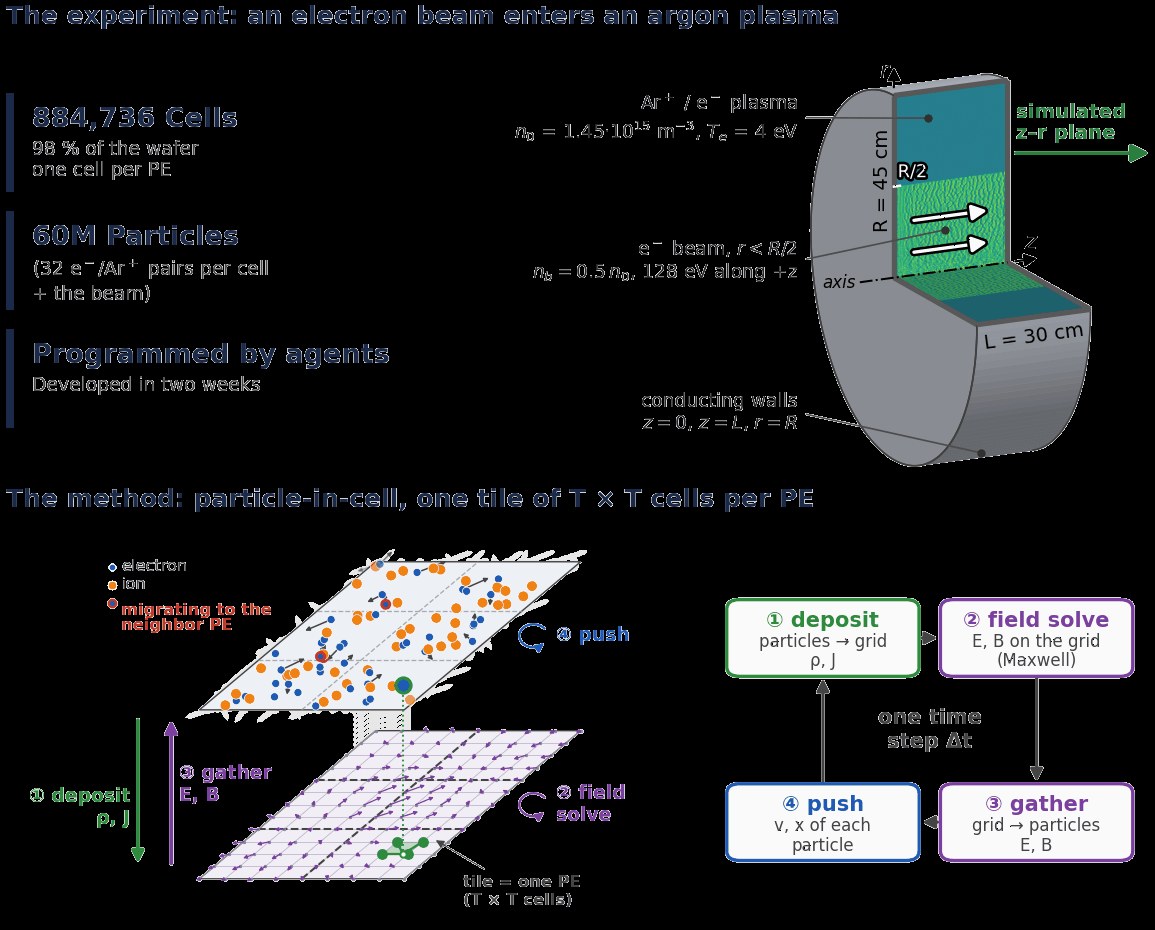
The particle-in-cell simulation is the worked example. Particles move under electromagnetic fields and migrate from core to core, while an implicit solver computes the fields from their positions and velocities. The problem models an electron beam entering an argon plasma, one cell per core, across 884,736 cells — 98% of the wafer, per the diagram Cerebras published with the announcement.
Cerebras says one researcher and one coding agent built it in about two weeks through a chat interface, with the agent writing every line. The agent worked from the published algorithms, validated its reference against the open-source XOOPIC code, modeled the problem on the EMPIRE plasma code, and wrote the tests, figures and documentation while finding and fixing its own bugs. Cerebras reports the full run advanced 60 million particles at 7,200 time steps per second — 430 billion particle updates per second on a single system. Co-founder Michael James still adds the plain caveat: learn the language yourself, because someone has to keep the agents on track.
What Aviary ships, and what is not proven yet
Aviary ranges from compact heat-equation and Gray-Scott reaction-diffusion tutorials — the Gray-Scott example is about 50 lines — to particle transport, sparse solves, fast Fourier transforms, molecular dynamics, plasma simulation and high-order hydrodynamics. Much of it grew out of work with Sandia, Lawrence Livermore and Los Alamos national laboratories under the National Nuclear Security Administration's Advanced Memory Technology program. Cerebras says the same Tungsten code runs on one wafer or across a cluster, citing a global tsunami simulation on 64 wafers.
The headline performance figures are Cerebras' own, with no independent replication in the release. Cerebras reports SNAP, a proxy for nuclear radiation transport, at 1.6 PFLOP/s on a single CS-4, ahead of 10,800 GPUs on the El Capitan supercomputer; HPCG at 1.04 PFLOP/s on a single system; and wafer-scale molecular dynamics 748 times faster than Frontier. Simulator runs in the Labs SDK check program behavior — they do not establish measured throughput on a physical wafer. A design optimizer that couples an AI model to a physics simulation as its world model is listed as coming soon, not shipped. The test that matters is whether outside researchers can move from Aviary's examples to their own codes without going back to hand-routed fabric.